


The AI adoption challenges in Africa have quietly changed shape, and most teams have not noticed yet. Two years ago, the question I got from business leaders across Lagos, Nairobi and Accra was whether they should be using artificial intelligence at all. Today almost nobody asks me that. They have bought the tools. They have run the pilots. They have a chatbot on the website and an automation somewhere in the finance workflow. What they ask now is quieter and far more uncomfortable: why is none of this showing up in the numbers?
That question is the whole story. Access is no longer the barrier. Execution is.
The Numbers Behind the AI Adoption Challenges in Africa
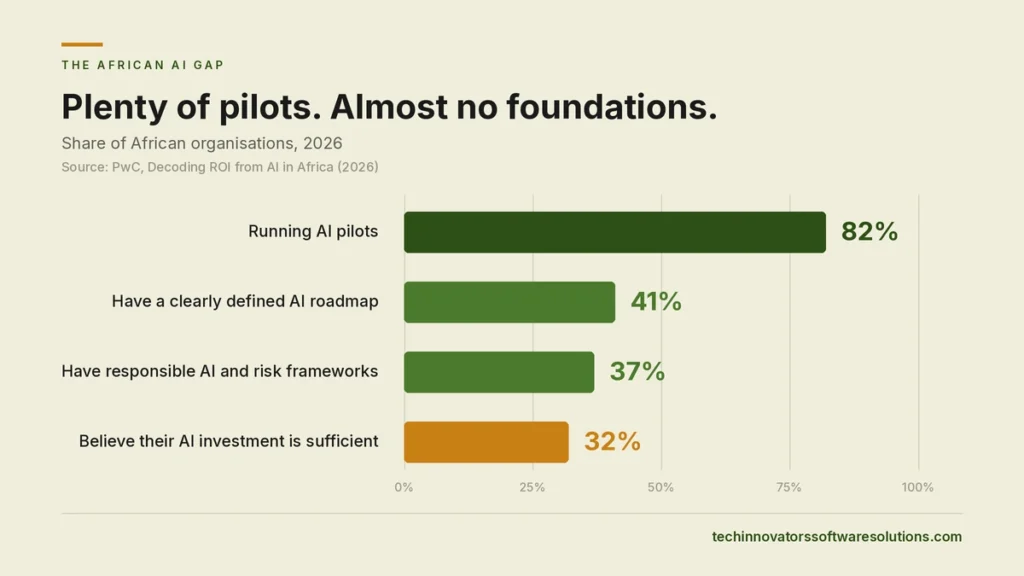
PwC’s 2026 research found that 82 percent of African organisations are running AI pilots. Taken alone, that reads like a victory lap for the continent. It sits almost level with the 88 percent pilot rate among the global AI frontrunners, which means we are starting projects at world class pace. Read the next few numbers and the picture changes completely. Only 41 percent of African organisations have a clearly defined AI roadmap. Only 37 percent have formal responsible AI and risk management frameworks. As PwC put it, the challenge is not adoption, it is execution at scale
The global picture offers no comfort either. Recent industry research puts the share of organisations seeing significant returns from generative AI at just 29 percent, and from AI agents at only 23 percent. Those are global figures, not African ones, which means this is not a continent specific failure. It is just landing harder here..
So we have near universal adoption sitting alongside near universal disappointment. As one analyst put it bluntly, adoption and competence are not the same thing.
This matters more here than elsewhere. African businesses do not have the budget cushion that lets a large multinational write off two years of failed pilots as a learning expense. When a Nigerian SME spends on tooling that produces nothing, that money is simply gone.
Why African AI Pilots Stall
I have sat in enough of these rooms to notice the same four failures repeating.
The Pilot Has No Owner
Somebody in operations sets up an automation. It works. Everyone is impressed in the demo. Then that person gets pulled onto a different priority and the workflow slowly rots, because nothing about it was ever anybody’s actual job. A pilot without a named owner and a defined success metric is not a project. It is a hobby with a budget.
The Data Foundation Was Never Built
AI agents are only as good as what they can read. If your customer records live across three spreadsheets, a WhatsApp group and one person’s memory, no model on earth will fix that for you. Teams keep buying intelligence and skipping the plumbing underneath it. The plumbing is boring, unglamorous, and the single highest leverage thing most African businesses could do this quarter.
Skills Are Assumed Rather Than Built
This is the one that surprises people. Across Africa, nine in ten organisations report significant impact from a shortage of AI skills. Yet most companies deploying agents have provided their staff with a login and nothing else. The assumption is that these tools are intuitive enough to teach themselves. They are not. A team that has never been taught how to scope a task, write a clear instruction, or check an output will produce mediocre results with the best tool in the world.
Governance Arrives Last, If At All
PwC Kenya’s technology consulting partner framed the core problem precisely: the workforce is ahead of the organisation. Employees are ready to use AI, but leaders are still building trust in decisions made this way. Bridging that gap is what determines whether adoption scales. Without a governance model, every promising pilot hits an invisible ceiling the moment it touches something that actually matters, like customer data or money.
What the Organisations Getting Returns Do Differently
The minority who are seeing real value share a few habits. None of them are exotic.
- They tie every AI initiative to a specific revenue or cost outcome before they start. Not “improve efficiency” but “reduce order processing time from four hours to thirty minutes.”
- They treat agents as products, not experiments. That means a roadmap, an owner, a feedback loop and a decision point where the thing either gets scaled or gets killed.
- They build the governance frame early, so that when a pilot succeeds there is a legitimate path for it to become part of how the business actually runs.
- They invest in their people at the same time they invest in their tooling, rather than eighteen months later when the results have not arrived.
Look closely at that list. Almost none of it is technical. Roadmaps, ownership, prioritisation, success metrics, stakeholder trust. These are product management and delivery disciplines. The AI adoption problem in Africa is a management problem wearing a technology costume.
A Practical Starting Point for African Teams
If you are somewhere in the 82 percent running pilots that have not gone anywhere, here is where I would begin.
- Audit what you already have running. List every AI tool and automation in the business, who owns it, and what it was meant to achieve. Most teams are surprised by how much is running unattended.
- Kill the orphans. Anything with no owner and no metric gets switched off. You are not losing value. You are stopping a slow leak.
- Pick one workflow that costs you real money. Order processing, customer follow up, reconciliation, reporting. One. Not five.
- Fix the data underneath it first. Get that one workflow’s information into a single, structured, reliable place before you point any agent at it.
- Train the team that will use it. Give them genuine capability, not a login. This is the step everybody skips and it is the step that separates the 23 percent from everyone else.
- Measure for ninety days, then decide. Scale it, fix it, or stop it. Make the decision explicitly rather than letting the pilot drift.
The Skills Question Nobody Wants to Answer
I write from experience here. When I documented my own process for building AI agents with Claude Code, the hard part was never the technology. It was knowing what to build, how to scope it, when to stop, and how to tell whether the output was any good. Those are learned skills, and they are the same skills that make somebody effective at product management training or at running a proper sprint through Scrum and Agile training.
This is the uncomfortable conclusion for a lot of African organisations. You cannot buy your way past a capability gap. The tools have become genuinely accessible, which means tooling is no longer a competitive advantage. Everyone has the same models. What separates the businesses that pull ahead over the next two years is whether their people know how to direct them.
That is also, honestly, the opportunity. Africa has leapfrogged before, most obviously in mobile money. We did it because we skipped the legacy infrastructure and built directly for how people actually operate. The same window is open now with digital transformation in Africa and agentic systems. Whoever closes the skills gap fastest gets to lead this one rather than follow it.
Ready to Close the Gap?
If your team is running AI pilots that are not producing anything you can point at in a report, the fix is almost certainly not another tool.
At Plunge into Tech, we train African teams in the disciplines that make technology investment actually pay off: product management, project delivery, Scrum and Agile, and hands on work with the digital tools your team already has open. Sessions run online or on site in Lagos, built around your real workflows rather than generic frameworks.
Book a free alignment call and let us look at what you are running, what is stalling, and what your team would need to learn to change that. Twenty minutes, no pitch deck.